It’s not easy to look at your own shadow


“It takes nerve not to flinch from or be crushed by the sight of one’s own shadow. It takes courage to accept responsibility for one’s own worst qualities.”  –Edward C. Whitmont, from “The Evolution of the Shadow,” in Meeting the Shadow


It’s not easy to look at your own shadow. 

In order to make our parents happy we started covering up parts of ourselves before we could walk. And we definitely knew the difference between approval and disapproval before we could talk. It’s a basic survival skill. We can’t make it on our own as infants. We have to depend on the goodwill of others. So if we hear we’re too much trouble, or our poop stinks, or we’re too lively or too clingy or too stupid, we learn to stuff those parts down into our shadows very quickly. By second grade, hiding parts of ourselves in order to please other people has become second nature.

Which is not necessarily a bad thing. In order to become a thinking human being who can cooperate with other thinking human beings, some of that old animal instinctual nature needs to be controlled. “Letting it all hang out” just won’t work among intelligent mammals who’ve been honing their warfare skills in dominator societies for thousands of years.

So a bit of repression serves a useful purpose. It allows children to become functioning, cooperative members of society. We learn not to drown our baby sister, or hit our brother over the head with a baseball bat. We learn how to sit still and pay attention to others. We figure out that we are not the center of the universe. (Hopefully.)

But once we grow up, we have a responsibility to get curious about what happened to all that juicy emotional energy we’ve been repressing since childhood. Otherwise, we’re liable to end up becoming a danger to society anyway. For when we refuse to admit that we even have certain feelings, we exclude the possibility of dealing with those feelings rationally. If we don’t take any notice of—or responsibility for—whatever lurks in our shadow, then we set other people up for ambush by our unsupervised inner demons.

In the famous book by Robert Louis Stevenson, Dr. Jekyll was a perfect gentleman, a widely respected, highly cultured, upper class, sterling citizen who spent most of his daylight hours ministering to the poor and needy. Afraid to mar his perfect image, but full of unappeased desires—this was back in the Victorian age, you know—Jekyll created an alternate ego, Mr. Hyde, to act out the less respectable urges in his soul. Bad idea. Because when Hyde slipped out the laboratory door at night and headed straight for the seediest parts of London, Jekyll had no control over him. As time went on and Jekyll kept denying his influence, Hyde’s desires took ranker and ranker forms. He persecuted prostitutes, preyed on the weak, even committed murder. Disavowed by Jekyll’s civilized side, Hyde grew ever more warped, ever more bestial, ever harder for Jekyll to manage. Eventually?  You know it. Hyde took over. Jekyll became all Hyde, all the time.

There’s a recurring theme in movies and literature about taming the Beast, about soothing the savage soul. But for that to happen, someone in the story has got to pay attention to the poor old Beast. Conscious, thinking attention. And as in the outer world, so in the inner world: no creature thrives on neglect. No critter likes to be caged.

There’s a basic psychological rule that any instinctual character prowling around in your psyche will act better and be easier to handle if you can  (1) admit that it exists, and  (2) figure out what it wants. Then you can open negotiations with it. Then you can manage it without harming others. What’s the first step in AA’s famous 12-step program? Admitting you have a problem.

Let’s use selfishness as an example. We have a good strong symbol for selfishness in Western folklore—a dragon hunched over his hoard. Now dragons never actually use the treasure they steal. They just hoard it. Take it from other people, pile it up in a cave somewhere, and lie around on it. Fly out and terrorize the countryside occasionally. Breath fire. Eat whole cows and coy maidens.
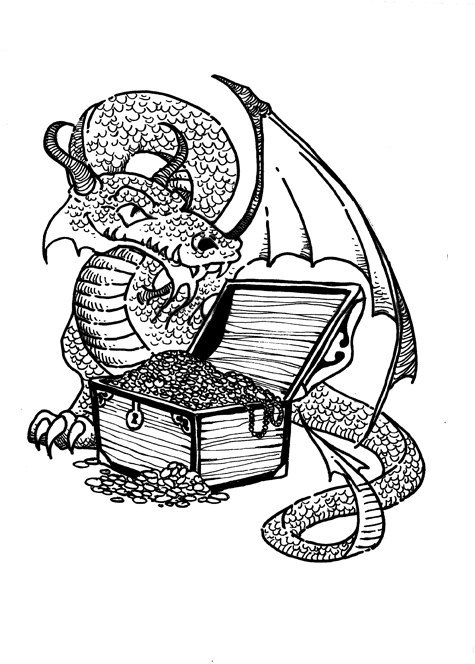
Can we better manage our internal dragon of selfishness by pretending not to be selfish, I’m not being selfish! I deserve a bigger piece than you do! Or by keeping an eye out for our selfishness, so that, when we catch ourselves being selfish, we can just admit it, maybe even laugh at ourselves as we see it happening? Geez, look at that! Cut my piece of pie a lot bigger than yours, didn’t I? I’m such a rascal. Here, let me divvy this up better.

That might work. But if we go around trying to pretend that we’re not selfish, then we’re never going to be able to stop being selfish. We’re never going to have an accurate picture of who we are or what we’re doing. Plus, we’ll have a lousy sense of humor. Where it starts to get ugly is: we’ll have to keep other people distracted, probably by accusing them of being selfish first, so they’ll be too busy defending themselves to notice how much bigger we just cut our own piece of pie.

What a lot of work for a little more dessert! And of course—and most importantly—the chance to appear free from all flaws. In black/white, either/or cultures which are quick to judge and harsh to condemn, children learn that it is very important not to be caught in the wrong, at a very young age.

But, alas… our old dragon of selfishness will only get bigger and more demanding the longer we pretend not to know anything about him. Like a troll under a bridge. Like Hyde. In fact, left alone without supervision, our internal dragon of selfishness will eventually get loose and swoop out over the countryside, torching people and grabbing whatever he wants. And if caught, he will always have good, solid reasons for his behavior. The Dragon of Selfishness can morph into The Victim of Circumstance in an eye blink.

The trick is to look within once in a while and admit that our internal dragon really is selfish, and that he really is a member of our psychic zoo. If we can do that, if we can even manage to say something directly to him occasionally like, “Oh, there you are. I see you, you greedy old thing,” maybe throw him a juicy steak or buy him a new toy, then the dragon of selfishness will settle down and go back to sleep. If we just allow him a little conscious space once in a while—not let him get away with anything, just acknowledge that he’s there—then he won’t have to torch or hoard or get 50 feet long or max out the credit card or have an affair or cheat on exams or embezzle company funds to get our attention.

“Medieval heroes had to slay their dragons; modern heroes have to take their dragons back home to integrate into their own personalities.”–Robert Johnson, Owning Your Own Shadow
DON’T MISS THIS MOVIE! Review of “Don’t Look Up”

“Don’t Look Up,” starring Leonardo DiCaprio, Jennifer Lawrence, Meryl Streep, Cate Blanchett, Rob Morgan, Kid Cudi, Timothee Chalamet, and a host of other fine actors and actresses, is wonderful.


It’s an intelligent and entertaining look (pun intended) at what happens when power hungry narcissists hold positions of power in governments funded by uber-wealthy donors.


Even when there’s an enormous comet hurtling toward the earth –certain destruction imminent, a mass extinction level event– those who can’t see a way to profit from it simply refuse to listen to the scientists.


Even when the comet has gotten so close that earthlings can see it with their own eyes, the powers that be refuse to listen to scientists. That’s when Streep’s party starts pushing the slogan, “Don’t look up!”


Instead they back a hair-brained idea by the third richest man ever –and Streep’s major donor– for dealing with the comet, and any scientist who disagrees with the plan is simply thrown off the project.


Perfect.


And just as dangerous whether it’s a huge comet coming toward us or a covid outbreak among us.


When I turned the TV off last night I felt hopeful for the first time in a long time. Really hopeful. We do have the stupids outnumbered, folks. We can pull ourselves out of the calamities hurtling towards us.


I love it when dire warnings are entertaining.


And this is your chance to get to see Meryl Streep playing Donald Trump. Look up if you want to, but don’t miss it.


What I wish someone had told me when I was a kid.


I’ve spent a lot of time thinking about how the Shadow operates in adults. But as a mother, grandmother, and frequent caretaker of other people’s children, I’ve actually dealt with how the Shadow operates in children more often than I have in adults.


Poor dears. They hate to be wrong. Hate to be caught in the wrong, that is. The most loving child will lie shamelessly to cover up a petty error that no one cares about anyway. Cannot stand to lose at games. Thinks nothing of cheating. And it takes a power of parenting to even make a dent in this apparently innate human outlook.


Then there are those of us who grow up in fundamental religious families, as I did. Where everything is black and white. Where your parents know all, their world view is iron clad and unassailable — divine no less — and no matter how ridiculous they act or how absurd they sound, you must honor and obey them on pain of corporal punishment and fear of eternal damnation. Where a child cannot afford to be caught making a mistake… Fertile breeding ground for the human shadow, indeed. If I’m not a good girl even God won’t love me. It takes children raised like I was a long time to be able to admit their own mistakes or to see a bit of their own Shadow. I will always struggle with an unconscious desire to be right, to know it all.


Here’s what I wish someone had said to me when I was a kid:

The best and brightest of us still make at least 3 or 4 mistakes every day. The very worst of us operate from a continual state of error. But most of us lie somewhere in between. We do a lot of things we can be proud of, we do a lot of things we can’t be proud of — that’s just the way it is.

Trying to pretend you haven’t made a mistake when you have made a mistake, trying to cover it up, merely adds another mistake to your running total. It adds telling a lie to what would have otherwise been just another routine slip-up.

Besides, we actually have to make mistakes. Human beings learn by trial and error.

So, give it up. You don’t know it all. You’re not always going to win. You’re not perfect.

Let go of being “right.”

You’ll be happier. You’ll develop a sense of humor about yourself. You’ll become less judgmental about others.

And you’ll be a lot more fun to be around.


Let’s call the USA what it is, a minoritocracy.


I’m making up a new word. The old one just doesn’t describe our situation anymore. This is not a democracy, where the majority rules. This is a minoritocracy, where a minority rules by any means necessary, chiefly obstruction and outright lying.


One person, Mitch McConnell, from the tiny and sparsely populated state of Kentucky, has managed to block legislation and kill judicial appointments that effect the entire country for years.


One person, Joe Manchin, from a state that leans hard on government handouts, is keeping all the rest of us, in all the other states, from benefitting from the Build Back Better plan.


We need to stop bleating about how democratic the USA is and make our democracy actually work. How can we ever hope to address serious problems like worldwide climate change when we can’t even agree on how to fix our own road and bridges?


And a large part of any cure? Establish some serious consequences for lying.


Sure… gerrymandering, legislative obstruction, and voting rights restrictions form part of our problem, but lying is the glue that holds it all together and makes minoritocracy work.


Anyone can say anything now, about anything or anyone, the more outrageous and untrue the better, without legal consequence. We just lived through the most corrupt President in history, and not only has he NOT suffered any legal consequences whatsoever, he’s planning on running again.


51 little Senators (all beholden to their big donors) should not be able to control the lives of hundreds of millions of Americans.


And no one — and no news media outlet — should get away with lying.


In a democracy, that is.


We’re all like Anna Karenina


“Happy families are all alike; every unhappy family is unhappy in its own way.”

That’s the famous opening line of Anna Karenina, by Leo Tolstoy. Which I just spent two days re-reading. Which I re-read every two or three years, actually. My copy is held together by postal tape now, and has highlighted passages and notes scribbled all over the margins, because something new always occurs to me while I read it.

(Confession: I adore re-reading books. You can see more deeply into characters you’ve already met in situations where you’ve already been. Plus, you can skim over passages that no longer apply — like philosophical or political issues of 1875 — without feeling guilty because you’ve already read them once.)

This trip through, what stood out was Anna’s inability to see her own faults. She could see that Karenin was half-dead, or that Vronsky was only interested in his own desires, or that her society was full of hypocrites. She could see the faults in others. But in herself? No way.

She could not accept that she, herself, ever did anything wrong. So the more “wrong” she did, by the standards of her time, the more her psyche split in two. Her charm and beauty morphed into weapons, rather than gifts.  She started refusing to answer hard questions, while looking down and away from the questioner with half-closed eyes.

“The thought of the harm caused to her husband aroused in her a feeling like repulsion, and akin to what a drowning man might feel who has shaken off another man clinging to him. That man did drown. It was an evil action, of course, but it was the sole means of escape, and better not to brood over these fearful facts.”

By the end of the book, Anna is a roaring drama queen who flies into daily rages and relies on morphine to get through the night. Then she kills herself to punish Vronsky for things he didn’t even do. She simply goes nuts.

I  know, I know. She was a young, beautiful woman living in a highly restrictive culture who married a stodgy older man when she was 18 years old. She’d probably never heard of an orgasm until she met Vronsky, much less had one. I cut her slack for all that. I have great sympathy for women whose passions were/are squelched by their cultures while their men lived/live large. Conditions like that make you crazy.

But what would’ve happened if Anna had stopped blaming and cut the drama? What if she’d simply taken the divorce when Karenin first offered it? What if she’d stopped creating untenable situations that were doomed to fail because she couldn’t bear to face her own guilt?

One of the reasons this novel is so famous is that we can all relate to Anna. We’ve all been there, at one time or another. We’ve all gotten dramatic or violent to change the course of a narrative when we should have gotten introspective. We’ve all pretended that there was absolutely nothing else we could have done, when in fact there were several other things we could have done. We’ve all spent a lot of time pointing out what others were up to, to keep from seeing what we were up to ourselves.

Denial? Blame? Substance abuse? Obsessive relationships? Self-destruction? Anna Karenina, written in 1875, is just as compelling, just as true, as ever.


Can we face up to our past?


Michele L. Norris has written an excellent essay, “Germany has faced its horrible past. Can we do the same?” which appeared in the Washington Post on June 3rd. Here’s the link:


https://www.washingtonpost.com/opinions/2021/06/03/slavery-us-germany-holocaust-reckoning/


In it, she outlines the process that Germany has gone through –and continues to go through– to face up to the horrors it perpetrated as a country in WWII. Which approaches have worked well, which approaches haven’t worked so well.


And then she asks an extremely timely and important question: can the USA do the same?


Can we face up to our history, which includes genocide and forced relocation of native populations, as well as 246 years of lawful and institutionalized slavery, followed by decades and decades of overt ‘Jim Crow’ oppression (which is staging a comeback with voter “restrictions” and police brutality)?


Can we accept responsibility for the bad as well as the good in our history? Can begin to move forward without blinders on? Or will we continue to try to sweep our sins under the carpet until denial, projection and blame tear us apart?


This is the very conversation we need to have.


Amnesia is not atonement.


Educational inequality in the US of A


Now that my kids are all grown up and have kids of their own, I live in a beautiful rural spot. I would have never lived in this beautiful rural spot while my kids were still at home. Back then I chose a dwelling according to its corresponding school system: the best neighborhood, with the best school system, that I could possibly afford.


What that says about the Unites States is appalling. It means that we all participate, every day, without thinking about it, in an educational system designed to reward those who are already well off while punishing those who are not. By basing public school funding on local property tax revenues, the United States overtly and covertly perpetuates inequality in education. A child whose parents can afford to live in a good neighborhood in a big city can get a good education in public school. A child whose parents can’t afford to live in a good neighborhood in a big city is on their own.


Yesterday afternoon I waited where my gravel road joins the paved road while local kids piled off the school bus. The little kids looked pretty much like little kids everywhere look. Excited to be alive. The older kids, the middle schoolers, looked pretty down in the dumps. I thought about that as I drove to a doctor’s appointment.


What if you’re one of those middle schoolers getting off the bus yesterday whose parents are–and will probably always be–achingly, grindingly poor?


And what if your only ticket out of a similar life of poverty was the public school system in a rural county in the United States of America?


Democrats Need Harder Shells and Sharper Claws


I’m lucky enough to have a wise old friend to call whenever I need a long rambling think about what it means to be human. During and after the Trump era, we’ve needed a lot of time on the phone.


In the 1970s, when my friend and I first met, we were both hard-working young mothers. It was still possible to live well on $800 a month back then, and we did. We ate natural foods, wore Birkenstocks, rather sporadically tried out new forms of meditation and yoga, and endlessly discussed the best way to deal with each phase our children went through. We volunteered in schools, were important forces in our neighborhoods, juggled home life and careers. Idealistic and optimistic, we believed that the world was changing for the better, and would keep changing for the better, while the musicians we listened to assured us that love was all we needed. That war was a bad thing. That peace was possible. That all we had to do was imagine a better world.


Fast forward to 2021. Instead of living in the 70s, we are 70, and it’s obvious that love is not all we need.


In 2000, when a Republican-majority Supreme Court gave the election to Bush before all the votes had been counted, my friend and I both thought we were going to die. The process took weeks, with the final count going back and forth and back and forth between candidates, and by the end of that time we were both physically ill. Disappointed and outraged enough to be physically ill. How in the world could an undemocratic power grab like that happen in the United States of America?


Fast forward to 2021, with Donald Trump flat out saying he’ll do whatever it takes to stay in power as he urges his followers to violence, while those who hope to benefit politically or economically (Fox News) from his fan base spread scandalous, traitorous lies about the election results.


What is going on here? Whatever happened to peace, love, and civil rights? Whatever happened to democracy?


For one thing, a failure of imagination. But not a failure to imagine good things happening, ala John Lennon. A failure to imagine how many truly frightening varieties of human nature there are.


In any given population, 4% — or 1 in every 25 people — will qualify clinically as sociopathic if tested. (i.e., devoid of compassion for others, scornful of the rules, driven only by power.) Then add in borderline personalities and narcissists and all the other destructive psychological tendencies in the human dictionary, and what you’ll end up with is the realization that there are real kooks out there, folks. Lots of them. And real kooks are often charismatic enough to sway others to their cause.


Real kooks do not listen to John Lennon or CSNY. They are not swayed by beautiful lyrics or concern for others. Real kooks are only out for themselves and will happily break any law they can get away with breaking. While the rest of us form an orderly line to do the right thing, real kooks cut in front.


My friend and I are both glad the era of ‘peace and love and hope’ is over. We’re tired of feeling disappointed and disillusioned to the brink of madness. We’re both ready to move on to the era of ‘examining the cold hard facts.’ And one cold hard fact is: human beings are much closer to animals than they are to angels.


What, exactly, is the difference between Donald Trump and a bull elk during mating season? They each have elaborate head gear. They each bellow and strut and butt competitors out of the way. They each want sole control of the babes and the territory no matter what. The only real difference is that no one will ever call Donald Trump majestic.


And who, having ever been around a blue jay, could doubt that self-promotion is one of the calling cards of creation on this planet? What could possibly be more bent on world domination than the common dandelion?


Human beings are just one small part of an unimaginably old and incredibly complicated evolutionary process, and judging by the mess we’ve made, very possibly a dead end. A slight mistake in the never ending process of creation, on a little blue planet with a unique but fragile atmosphere whirling in a spiral galaxy among millions and millions of other galaxies. Smarter than the elk or the dandelion, but still too greedy, bull-headed and selfish to share power or resources, hence most likely doomed to extinction. But if you get a chance to watch stars and planets cross the sky on a dark, clear night, it may occur to you that such an outcome would be perfectly OK. It’s a pretty big universe. We won’t be missed.


I’m not saying that we shouldn’t be appalled at Trump and the whole Republican party in the here and now. Certainly we should be! We should be doing all we can to make our country more just and fair, all we can to make this world a better place, all we can to remedy the evil we’ve caused… all we can to make ourselves better people. But it’s become clear that the extent of my disillusionment during and after the Bush/Gore debacle — and many, many times since —  is directly proportional to my naive belief that people are basically good and that love will prevail.


Get over it, girl! It just ain’t so. (And it never has been so. Any perusal of any period in human history will make that perfectly clear. The Tudors and the Borgias poisoned or beheaded people who got in their way.)


I’m saying that ‘hoping everyone will play nice and that things will turn out for the best’ merely leads to outrage and disappointment in good people while it allows the brutes to take over.


The Republican Party does not have a majority. It hasn’t had a majority in decades. So why are Republicans still in power? By continuing to embrace the outdated electoral college, by gerrymandering, by filibustering, by voter suppression, by lying shamelessly about their opponents, by lying shamelessly about whatever just happened, by turning what ought to be personal decisions (whether or not you have children; whom you can marry) into divisive political issues. The Republican minority is still in power because the rest of us have failed to keep it in check.


So my friend and I have decided that we don’t need any more hope, thank you very much. Nor peace, nor love, nor anything touchy-feely, pie-in-the-sky, airy-fairy, or PC… None of that, thanks.


What we really need is a hard look at human beings as they actually are, and laws about governmental standards and election procedures with real teeth in them.


Harder shells and sharper claws.


Never write a book about anything important


https://www.washingtonpost.com/magazine/2021/03/29/qanon-new-age-spirituality/?itid=hp_magazine

     Because as the above article shows, ignoramuses can and will turn your words inside out and totally distort whatever you said in the book. The better you said it, the better their arguments will be.
     Poor Robert Bly.
     Humanity has reached the dismal state where great masses of it will believe anything. Incapable of thinking for themselves, and too ignorant to adequately process complex ideas, this group invariably misunderstands complex ideas. These folks can think of themselves, and how special they are, but that’s as far as their thinking can take them.
     The problems highlighted in the article above are exactly what I ran into while a member of the Oregon Friends of Jung. Meeting monthly –obstensibly to discuss the ideas of one of the most original minds humanity ever produced, one of the ‘big three’ fathers of modern psychology– did they actually do that? Did they want to delve into difficult and troubling concepts like the human shadow? Of course not!  Accept for the hard-hitting James Hollis and Karl Marlantes (whom I scheduled once, with great difficulty), they wanted to hire lecturers on astrology and other such ‘make you feel good’ navel-gazing diversions. While board members, my husband and I dutifully sat through countless lectures so muddled they were meaningless. Jung would have crapped his pants in frustration.
     If one slithered by right now, I could bite the head off a rattler.
     Because the author of this article is right. There is a connection between “New Age” concepts and QAnon.
     That connection is rampant narcissistic ignorance incapable of processing complex ideas.

This blog post is not politically correct


I just got off the phone with my step-son, who had just tried to conduct a conversation with his birth mother, a borderline personality. He was justifiably upset.


My own mother was a borderline personality. So is the ex-wife of one of my son-in-laws. That’s three really toxic people, in this one little circle of extended family. (And not related to one another by birth.) Three people who do not listen to others, swing wildly from clinging to attacking, cannot be depended upon, lie without even realizing it, and simply don’t care what the facts are. Three different people, in this one extended family, who are incapable of using reason to make decisions; they live only to defend whatever crazy thing they just said or did, and wreck havoc wherever they go.


The question in my mind today is, does this ratio hold true in the larger population? We already know that about 1 in every 25 people are sociopathic. Then how many are borderline personalities? How many are narcissists? Just how many people in any given population are mentally and emotionally incapable of registering facts, even when those facts are biting them in the ass?


No wonder it’s so hard to practice democracy.


And, could these ratios explain what’s happening to the Republican party? Has it been gradually absorbing all those who are too mentally unbalanced to care about what happens to other people? Has it become the Party of Brain-Wiring Misfires?


Told you this post would be politically incorrect.